
1. What is PolyAI?
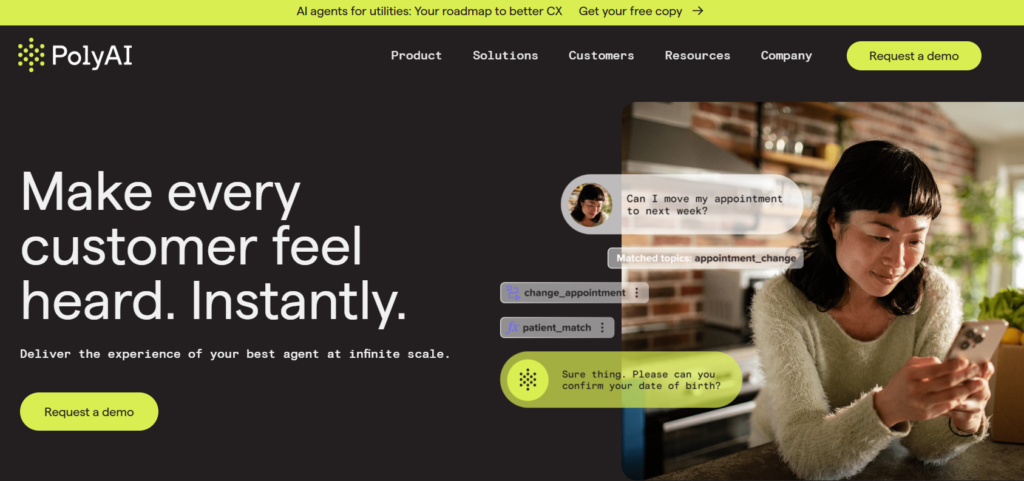
PolyAI is an enterprise-grade conversational AI platform that builds voice and chat agents for customer service and support. It’s designed to let businesses automate customer interactions — phone calls, chats, support requests — but in a way that feels natural and human-like instead of robotic or scripted.
If you run a business that deals with lots of customer calls — whether it’s banking, hospitality, retail, telecom, or any industry with frequent customer contact — PolyAI offers a way to handle high volumes without sacrificing customer experience. Instead of forcing every call through a rigid IVR or basic bot, this tool aims to sound like a real person, understand what customers want, and guide them through their requests smoothly.
PolyAI was founded in 2017 by a team with a major AI/ML research background.
2. How to Use PolyAI (if You’re a Business Looking to Deploy It)
Using PolyAI isn’t like installing a small consumer app — it’s more like onboarding a full-scale AI assistant for your company. Here’s generally how it works:
- Consultation & Planning
You start by sharing your company’s needs: volume of customer queries, languages required, typical use cases (billing, reservations, customer support, etc.). PolyAI works with you to design a solution. - Agent Design & Configuration
The PolyAI team (or your integration partner) defines the conversation flows, sets up dialogues, integrates with your systems (billing, CRM, order management, etc.), and customizes the voice/response style. - Training & Testing
Before going live, you test the voice assistants under real-world conditions: check whether they understand intent, handle edge cases, respond naturally, and integrate properly. - Deployment
Once everything tests fine, the voice agent is deployed. It can answer calls or chats, route requests, handle transactions like billing, orders, and reservations, or escalate to human agents when needed. - Monitoring & Continuous Improvement
PolyAI provides analytics and performance data so you can monitor how well the AI handles queries, where human agents are still required, and continuously refine the system.
Because this is enterprise-level, the process tends to be more involved than a plug-and-play bot.
3. Key Features of PolyAI
Here are the standout capabilities you’ll get with PolyAI, as used by real companies:
Natural, human-like voice agents
PolyAI agents are built to sound and respond like real customer service representatives. Many callers reportedly can’t tell whether they’re talking to a human or AI.
Multilingual support and wide-scale deployment
The platform supports dozens of languages and is suited for global enterprises operating across countries and customer demographics.
Integration with business systems
PolyAI can integrate with existing enterprise systems — CRM, billing, order management — allowing the AI to fetch or update customer data or order status, handle transactions, bookings, payments, and more.
Versatile use cases across industries
Whether it’s banking (account queries, auth, support), hospitality (reservations, bookings), insurance, retail, telecom — PolyAI’s conversational agents can adapt to many types of customer interactions.
Analytics & continuous optimization
Once deployed, you get access to analytics about call volume, resolution rates, where AI struggled, and where human handoff happened — giving insights to improve customer experience and reduce costs.
4. Pricing (In a Table)
Because PolyAI is designed for enterprises, pricing isn’t fixed and publicly listed. It’s customized based on business size, usage volume, integration complexity, languages, and support needs.
| Plan / Deployment Type | Estimated Cost / Pricing Model | What’s Included / Key Features | Best For |
| Custom Enterprise Deployment | Custom quote; many contracts start at around USD 150,000/year for full-scale use | Full voice assistant deployment, multilingual support, integrations, analytics, maintenance | Large enterprises, high-volume customer support operations |
| Scaled Voice Agent Usage | Pay-per-minute model (for ongoing voice assistant calls) | Continuous maintenance, updates, 24/7 support, scalable voice traffic handling | Organizations needing flexible scaling or variable call volumes |
Because there’s no public free plan or small-tier “starter package,” PolyAI tends to be most suitable for medium to large businesses with substantial call or customer-support volume.
5. Pros and Cons of PolyAI
Pros
- Conversations feel natural and human-like, not robotic or scripted
- Strong multilingual support and global scalability
- Seamless integration with existing backend systems (CRM, billing, orders, etc.)
- Handles high volume, enterprise-scale customer interactions — great for larger companies
- Analytics and continuous optimization help improve customer experience over time
Cons
- Pricing is high and customized — not ideal for small businesses or startups
- Onboarding and deployment require planning, integration, and testing (not instant setup)
- It may be overkill for businesses with low call/chat volume or simple customer support needs
- Because it’s enterprise-oriented, flexibility for small-scale experiments is limited
6. Alternatives to PolyAI
If PolyAI seems too large or expensive for your needs, here are some alternatives you might consider:
- Google Dialogflow — Good for smaller or medium-sized chatbots. Offers both text and voice-based conversational AI, with a simpler setup, and often suitable for websites, small customer support flows, or prototypes.
- Amazon Lex — Amazon’s conversational AI tool that integrates with AWS ecosystem, useful for businesses already using Amazon’s cloud stack. Flexible for both chatbots and voice assistants.
- Five9 Virtual Assistant — Provides cloud contact center solutions, including virtual assistants. More accessible for mid-size companies than full-scale enterprise deployments.
- Smaller open-source or self-hosted chatbot frameworks — If you prefer full control and a lower budget, frameworks that let you build custom chatbots may suit better, though you’ll need technical resources.
Each alternative offers trade-offs: lower cost or easier setup, but often fewer features, less scalability, or less natural voice experience compared to PolyAI.
7. Final Words
If you run a business with large-scale customer support needs — lots of calls, multilingual customers, high volume — then PolyAI can be a powerful tool to automate support while retaining a human-like conversational experience. Its integrations, voice quality, analytics, and scalability give real value for companies that need enterprise-level performance.
If your needs are small or you’re just starting out, you might find the pricing and setup effort too heavy. In that case, one of the lighter alternatives could make more sense to begin with.
If you like, I can also write a short overview version of this review (for quick sharing), or a comparison table of PolyAI vs 2–3 top alternatives.

